The Best OBS Setting for Streaming [2026 Guide]
The quality of your stream can be significantly improved by selecting the best OBS settings for streaming. If your settings are too low, your video may appear pixelated or choppy; if they are too high, your files can become large, take up too much space, or be difficult to upload and share. This is where OBS Studio bitrate and RTMP streaming setup enter the picture for a stable streaming setup for Twitch. By selecting appropriate bitrate settings, you can be assured that your audio and video output quality will always be high. In this article, we explore some of the best OBS stream settings to help creators configure OBS effectively.
Part 1: Best OBS Settings for Streaming - Common Settings for Everyone
One of the most crucial variables for live streaming is upload speed, especially when dialing in a consistent OBS setting for streaming. Your live streaming will be more fluid the faster your upload speed is. The recommended upload speed is often in the range of 5 Mbps. Let's examine the additional key stream parameters and OBS settings you must modify to build good settings for OBS across different use cases.
Step 1: General Settings
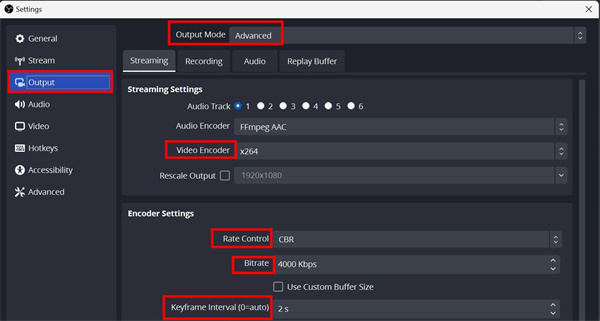
- Launch OBS Studio and go to "Settings" in the lower right corner of the screen. On the left, tap on the "Output" tab to access core OBS stream settings.
- To view more options, switch the "Output" mode to "Advanced" to manage recording formats like MKV or MP4, which is recommended in most OBS setups for flexibility and editing efficiency.
Step 2: Video Settings
- Set your "Video Bitrate" to 4000 Kbps as a baseline OBS video bitrate for pixel-perfect live streaming. It is the ideal bitrate for OBS when targeting 1080p at 30 frames per second with stable performance.
Step 3: Audio Settings
- Increase the OBS audio bitrate to 320 Kbps if you are streaming music or podcasts, ensuring professional-grade sound clarity.
- On the other hand, most services recommend 160 Kbps for general content such as gaming or talk shows.
- Explore more advanced OBS mic settings to further refine your audio chain.
Step 4: Keyframe Interval
Set the keyframe interval to 2, which aligns with recommended OBS broadcast settings and ensures compatibility with major platforms like Twitch and YouTube.
Step 5: CPU Usage Preset
Next, look at the CPU Usage Preset. Decreasing this parameter will result in better stream quality, which is essential for achieving best OBS settings for streaming.
A low setting, however, puts additional pressure on your hardware. If you believe your gadget isn't powerful enough to continue uninterrupted broadcasts, you can check solutions for OBS encoding overload to optimize performance and fine-tune your encoder settings OBS.
Bonus: Best Camera for OBS Streaming - OBSBOT Tail Air Streaming Camera
Now that you've learned the best OBS settings for streaming at 1080p/30fps, you must have a cutting-edge video-capturing camera too. For your convenience, here we bring you an AI-driven PTZ streaming camera, OBSBOT Tail Air. This camera is packed with a wide range of applications that offer multiple features like NDI streaming and AI tracking. The cutting-edge OBSBOT Tail Air camera truly shines in adaptability and performance for modern OBS streaming settings. You can easily record and stream your content on the go.
- NDI networking with Wi-Fi and Ethernet connectivity
- Lightweight and small as compared to other AI cameras
- AI Director Grids and AI Auto Tracking of humans, objects, and animals
- Record or stream at the resolution of up to 4K@30FPS and 1080p@60FPS
- Smart remote control app to control the camera on the go with just a tap on your smartphone
Part 2: Best OBS Settings for Streaming 1080p 60fps
Want to stream on Twitch using OBS? This section will help you understand the correct information about OBS settings for Twitch and how to properly configure OBS for Twitch.
Step 1: Check PC Display Settings
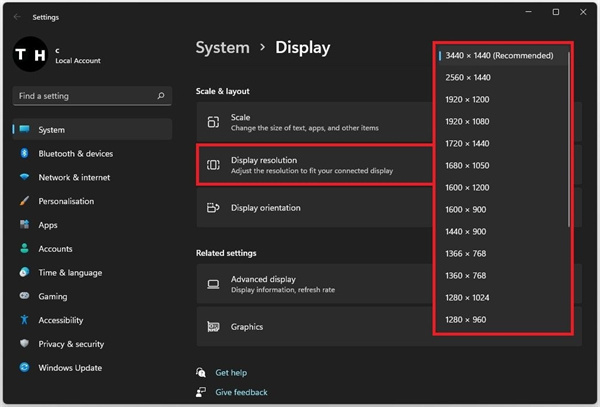
- Right-click your desktop screen and choose “Display Settings” to check its Native Display Resolution. Tap on the "Display resolution" and select the recommended option, which is critical when setting up OBS for Twitch.
Step 2: Adjust Video Settings as per PC Display Resolution
- Open the OBS window and go to “Settings” > “Video” > “Base (Canvas) Resolution,” and set this to the resolution of your PC. Then, set the "Output (Scaled) Resolution" to “1920x1080” for optimal OBS stream settings.
- If you want the finest image, set the "Downscale" Filter to "Lanczos"; however, this setting may cause your PC to stutter when streaming. For low- to mid-end PCs, we advise setting this option to “Bicubic.”
- Lastly, set the “Common FPS Values” option to “60”.
Step 3: Adjust Audio Settings
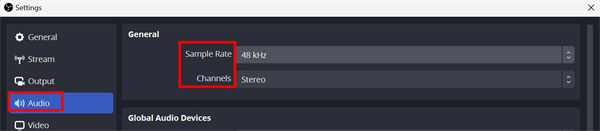
- In the OBS “Settings” section, get into the “Audio” tab and set the “Sample Rate” to 48 kHz for accurate sound in the video.
- In the “Channels” option, select “Stereo” from the Channels list.
- Now, go to the “Output” tab and set the “Audio Bitrate” to 320kbps, which aligns with recommended OBS audio bitrate standards.
Step 4: Encoding Settings
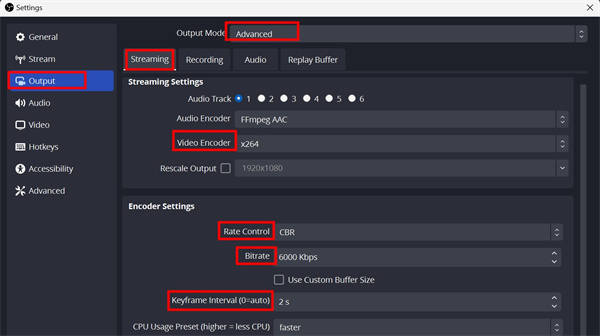
- Now, go to the “Output” settings, select “Output Mode” as “Advanced”, and then navigate to the “Streaming tab” to finalize OBS encoder settings.
- If you have access to a strong enough NVIDIA graphics card, select NVIDIA NVENC as the “Encoder” to maintain efficient OBS encoder performance.
- If not, set the encoder to x264, which will render your stream using your processor rather than your GPU.
Step 5: Rate Control and Bitrate Settings
- Select “CBR” as the Rate Control, and match your OBS stream settings bitrate to your available upload speed.
- For a resolution of 1080p and 60 frames per second, set the Bitrate to “6000”, which is widely considered a best OBS setting for smooth Twitch streaming.
Step 6: Keyframe Interval
- Change the Keyframe Interval to 2 seconds.
- Set the Preset to “Quality”, the Profile to “Main”, and leave the remaining options at their defaults.
Step 7: Stream settings
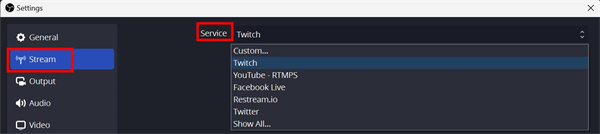
- Navigate to the “Stream” area of your preferences after making your adjustments.
- Choose the streaming provider you want to utilize and verify your OBS setting for Twitch.
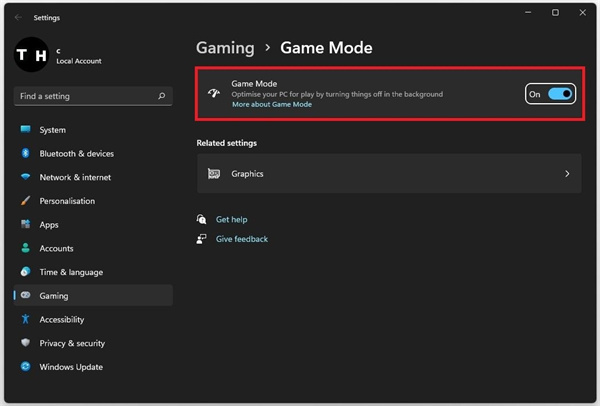
Step 8: Enable the Game Mode on your PC
Lastly, if you plan to stream games, enable Gaming Mode on your PC so that it can automatically optimize system resources for OBS streaming settings. Type "Game Mode" into the Start menu search box and activate it. Moreover, explore the game streaming setup to further enhance your live performance.
Part 3: Connect OBS with Twitch
Now, you must be wondering what the optimal OBS settings are for Twitch. All the recommended OBS setting for streaming scenarios have already been covered above. All you need to do now is connect your Twitch account with OBS Studio and apply the appropriate OBS stream settings for 30 FPS or 60 FPS.
Step 1: Launch OBS Studio and open the “File” menu. Select the "Stream" option and choose "Twitch" from the Service drop-down menu.
Step 2: Paste your Stream Key or use the “Connect Account (recommended)” option.
Step 3: Sign in to your Twitch account. OBS Studio will automatically retrieve account data and apply compatible OBS broadcast settings.
Step 4: Configure the settings for 30 FPS or 60 FPS based on your content and hardware.
Step 5:Choose a video source such as Game Capture, Window Capture, or Display Capture.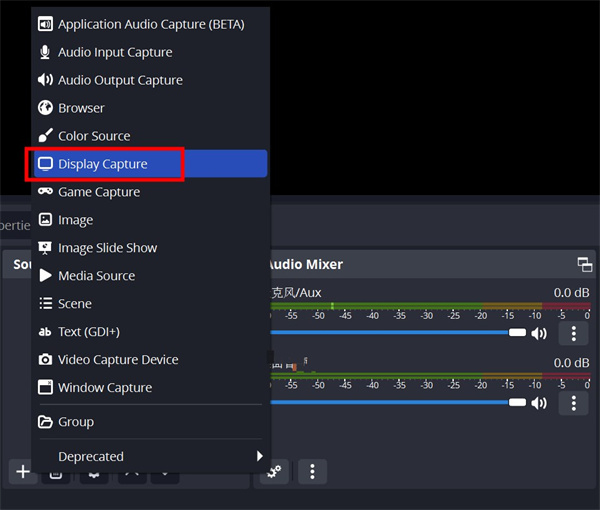
Step 6: Click "Start Streaming" to go live on Twitch.
Part 4: FAQs about OBS Settings for Streaming
1. What are the best streaming quality settings for OBS?
If you're streaming at 1080p@60FPS, set the bitrate between 6,000 and 9,000 kbps for optimal quality. These values represent good OBS settings for streaming across most platforms.
2. Why is my OBS stream quality so bad?
Poor quality usually results from misconfigured OBS stream settings, hardware limitations, or unstable internet connections.
3. What bitrate is 1080p 60FPS OBS?
For 1080p 60FPS, a bitrate range of 4,500–9,000 kbps is recommended depending on platform limits and encoder choice.
4. What bitrate is 720p 60FPS Twitch?
The recommended bitrate is 3,500–4,500 kbps.
5. How to fix OBS stream lag in 3 steps?
- Reduce Canvas Resolution to 1600x900.
- Set Process Priority to "Above Normal".
- Enable Network Buffering at 2000ms.
6. NVENC vs x264: Which Encoder is Right for You?
According to OBS Official Guidelines, NVENC is recommended for RTX GPUs, while x264 requires stronger CPUs for stable performance.
Conclusion
This guide has outlined a complete OBS setting for streaming strategy, covering video, audio, bitrate, and encoder configurations. By applying these best OBS settings for streaming, you can achieve consistent quality, efficient performance, and a smoother live experience. Always test your OBS streaming settings before going live to ensure optimal results.